


Does this sound familiar? Every week, between two urgent matters, someone on your team opens a spreadsheet or the accounting software to “do the reminders”. A list of overdue invoices, a few copy-pasted standard emails, one or two reminder calls… and on to the next thing. It's not very structured, but at least it's done. Until next week.
This is how many companies handle reminders, and it can seem practical at first. But it hides real weaknesses that can prove costly:
- Relationship risk: sending every customer the same reminders can damage relationships, especially with good payers. A poorly targeted message can create unnecessary tension.
- Misallocated time: you spend as much time on reliable customers as on those who regularly cause problems, which is neither productive nor strategic.
- Badly timed legal action: without a differentiated reminder workflow, you escalate too early or too late, which makes you less effective or costs you credibility.
- Administrative burden: handling reminders case by case, without segmentation, weighs on day-to-day work, wastes time and creates unnecessary stress.
Segment your customers for better reminders
You don't need complex tools to improve your reminders. There's a simple method we recommend to every company: segmenting your customer base. By grouping customers according to their payment behavior, you can adapt your message, your timing and your actions in a targeted, effective way, without adding to your workload.
How do you segment your customer base in practice?
An export from your accounting software or CRM, a spreadsheet and a methodical approach are all you need. Here are the key indicators to analyze for each customer:
- Average days late (payment date vs due date)
- Average number of reminders needed
- Length of the relationship
- Average or total amount invoiced
- History of disputes or broken promises to pay
By combining these few data points, you can sort your customers into a handful of typical profiles. These three come up most often:
VIP customers
Your most valuable customers: loyal, regular and strategic for your business.
Typical criteria:
- A customer for several years
- Above-average order value
- Always or almost always pays on time
- A business relationship to protect at all costs
Bad payers
Customers who regularly cause problems: chronic late payment, broken promises, one excuse after another.
Typical criteria:
- More than 30% of invoices paid over 15 days late
- Several reminders needed before they pay
- A history of disputes or broken commitments
- No apparent willingness to improve
Standard customers
They make up most of your portfolio. By default, this group covers every customer who doesn't fit the 2 categories above.
Typical criteria:
- Usually pay on time, with occasional slips
- Invoices of standard amounts
- No notable signals, positive or negative
A dedicated reminder workflow for each type of customer
Once your customers are segmented, it becomes much easier to build tailored reminder workflows that are both more effective and more respectful of the business relationship. The right tone, the right timing, the right channel: each type of customer deserves its own approach.
Here are three concrete reminder workflows to adapt for the VIP customer, the bad payer and the standard customer. In each one, D+10 means 10 days after the due date and D-5 means 5 days before it.
VIP customers: protect the relationship
🎯 Goal: keep a relationship of trust and avoid tension
📬 Number of reminders: 3 to 6 interactions, ideally at least 3
📡 Channels: mainly email, with a call only when really needed, to avoid “putting pressure on the customer”
🗣️ Tone: personal, courteous and understanding, to show you're listening
Recommended reminder steps:
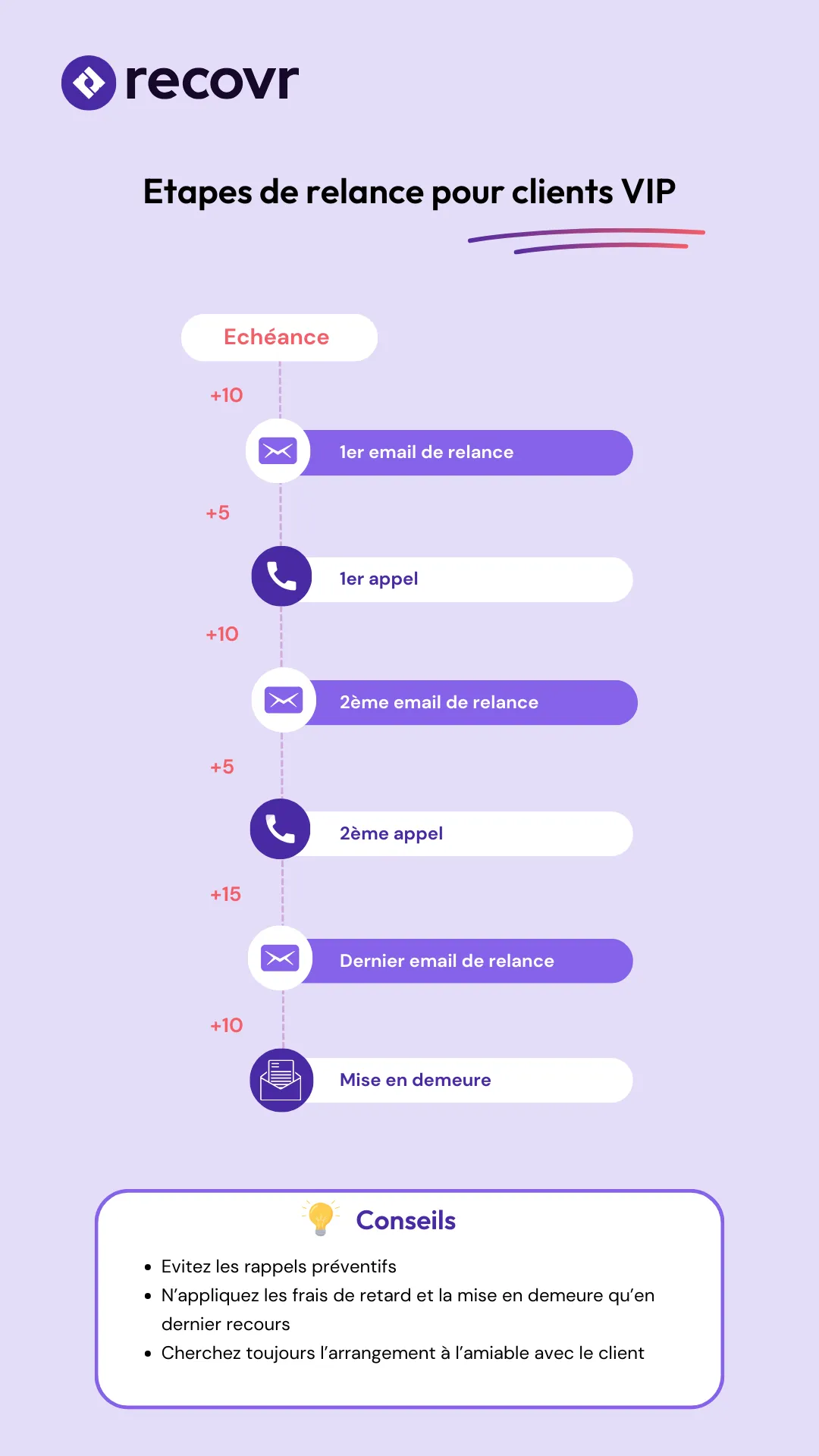
- D+10: First reminder email, courteous tone
- D+15: First call, from the person who usually deals with the customer
- D+25: Second reminder email
- D+30: Second call
- D+45: Final reminder email before the formal notice
- D+55: Formal notice sent
For these customers, skip preventive reminders (sent before the due date) so you don't come across as pushy. Likewise, don't escalate too quickly to late fees or formal notices. Always look for an amicable arrangement first (a payment plan, a later payment date, etc.) and talk to the customer by phone before taking legal action.
Bad payers: anticipate and stay firm
🎯 Goal: protect your cash flow
📬 Number of reminders: 4 to 5 interactions, with an early formal notice
📡 Channels: email, registered mail
🗣️ Tone: assertive, clear and firm (less leniency)
Recommended reminder steps:
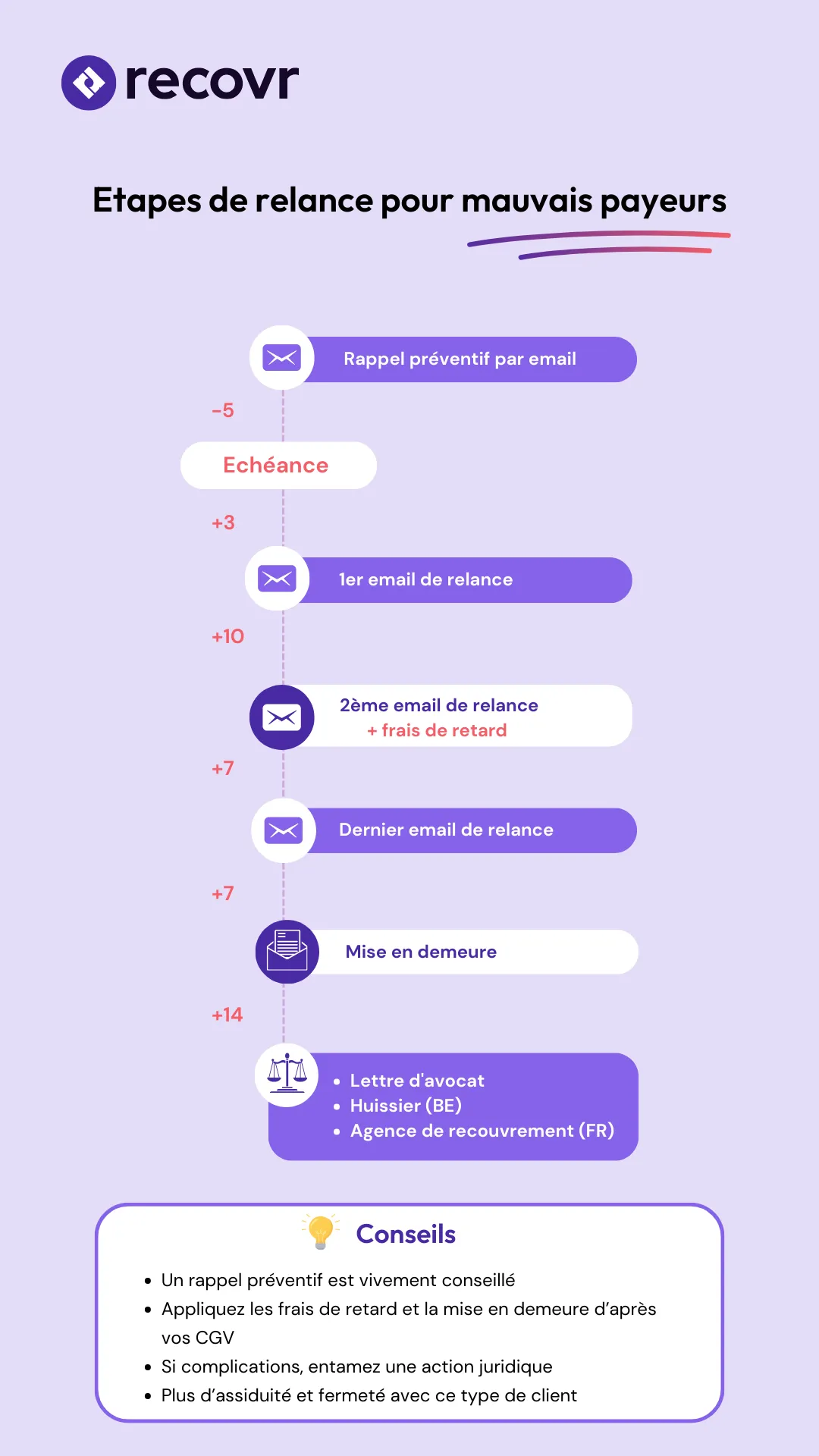
- D-5: Preventive reminder by email
- D+3: First reminder email, mentioning possible penalties (late fees)
- D+13: Second reminder email, with late fees applied
- D+20: Firm final reminder
- D+27: Formal notice sent
- D+41: Legal action: a letter from a lawyer, or the case handed to a bailiff (Belgium) or to a collection agency (France)
With bad payers, the preventive reminder can be strategically important: it protects your cash flow and helps you spot potential problems early. Use every tool provided for in your terms and conditions, such as late fees and formal notices. The goal here is to get paid as quickly as possible.
Standard customers: clear, firm and respectful
🎯 Goal: speed up payment without damaging the relationship
📬 Number of reminders: 6 interactions
📡 Channels: email, phone and letter
🗣️ Tone: professional, increasingly insistent if the customer doesn't respond
Recommended reminder steps:
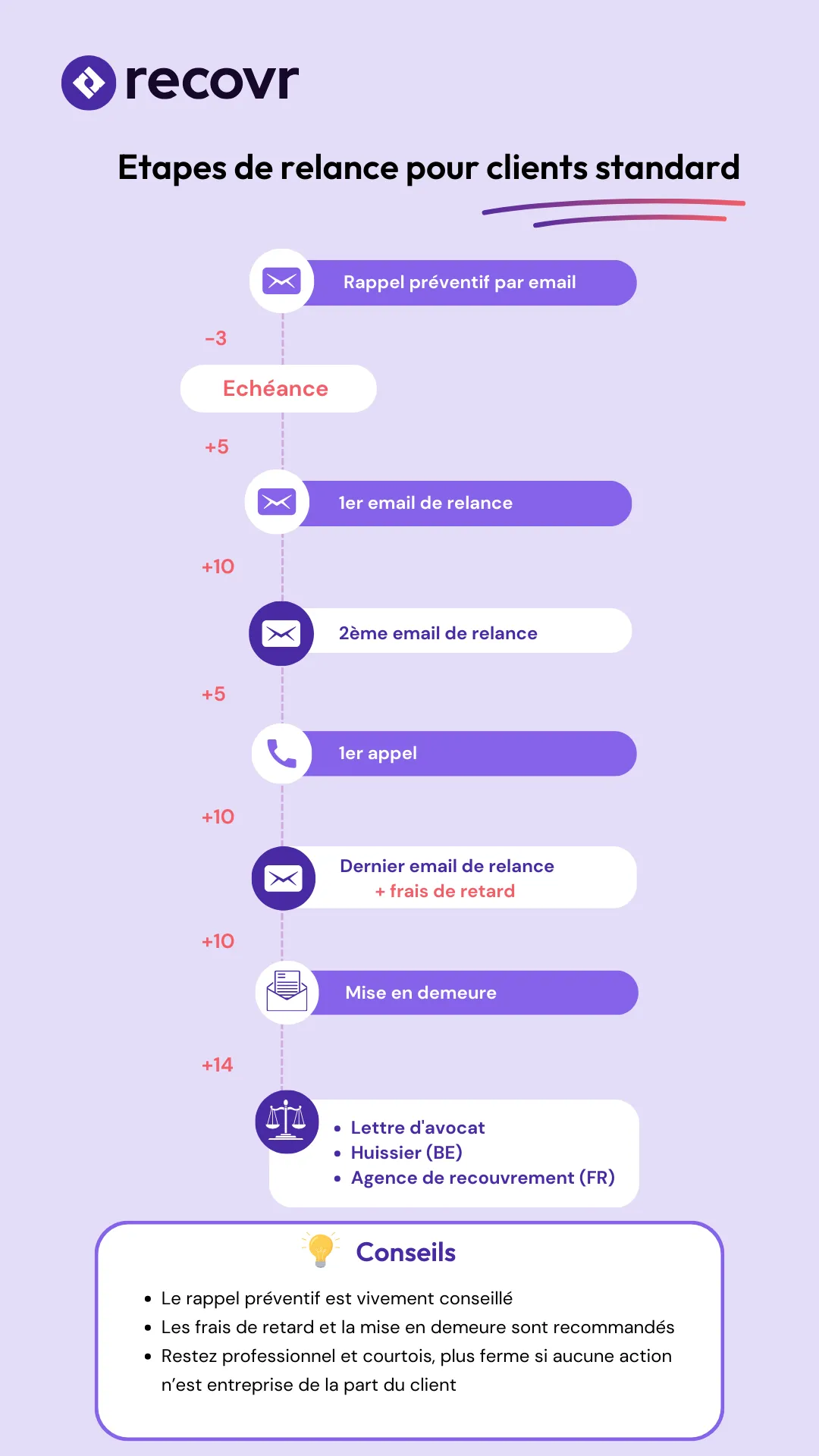
- D-3: Preventive reminder by email
- D+5: First reminder email, in a firm tone, restating the amount and the invoice terms
- D+15: Second reminder email, mentioning possible penalties
- D+20: First call, to talk things through and understand what's holding up payment
- D+30: Final warning by email, in a firmer tone, with late fees applied
- D+40: Formal notice sent
- D+54: Legal action: a letter from a lawyer, or the case handed to a bailiff (Belgium) or to a collection agency (France)
As with bad payers, we recommend a preventive email before the due date, to head off any honest oversight. Start out courteous and firm up the tone with each interaction, while offering the customer some flexibility if needed (a payment plan, for example). Late fees are recommended from the 3rd reminder email onward, to speed up payment. If the situation gets more complicated, consider legal action (lawyers, bailiffs or collection agencies).
Segment your customers and improve your reminders, starting today
A differentiated reminder process is essential to improve your cash management, work more efficiently and protect your business relationships. By segmenting customers according to their payment behavior and applying tailored reminder workflows, you get paid faster while building trust with your customers.
Of course, running these reminders without a dedicated tool remains a challenge, especially at scale. But with a sound segmentation method and a well-structured reminder system, you can make the work much lighter.
What matters is to start tailoring your reminders so they are more targeted and effective. To go further, a platform like Recovr lets you automate this process while keeping a personal approach, saving valuable time and improving your chances of collecting what you're owed. To see how to automate your payment reminders, talk to a Recovr expert.
Ready to take control of your receivables?
Recovr automates your reminders from first to last and leaves you in control of the exceptions.